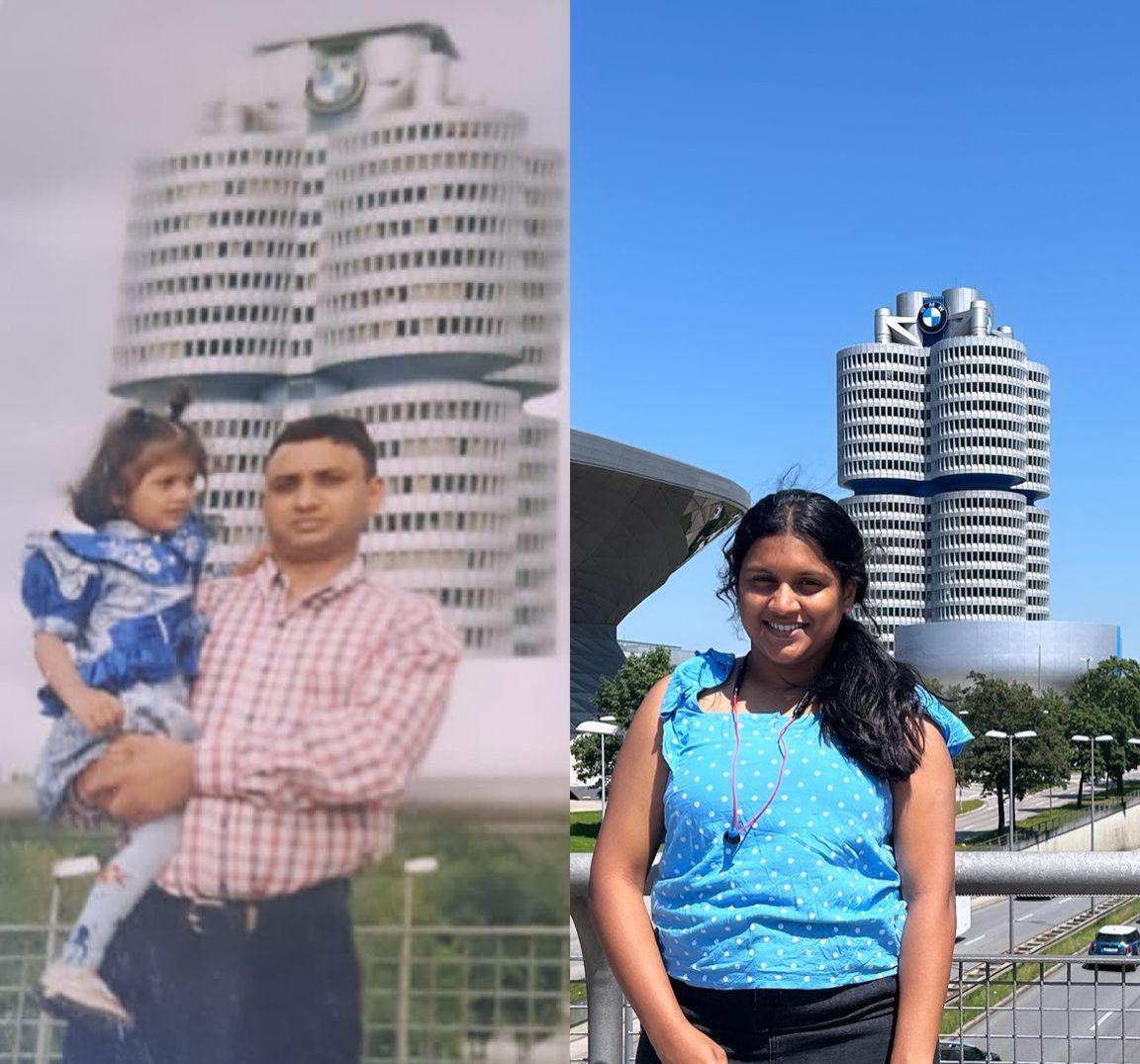
I was born to South Indian parents from Bangalore, and for the first few years of my life, we moved around the world thanks to my father’s job.
Both my parents were software engineers, but after I was born, my mother chose to step back from her career so she could pour all her time and energy into raising me and my sister.
Looking back, everything I am today rests on the two pillars they formed — my mother and father — each shaping a different part of me.
Growing Up With Arts, Language, and Culture
Outside school, my childhood was filled with Carnatic music and Bharatanatyam. I even trained in Yakshagana.
Alongside that came my formal training in Sanskrit and Hindi — mostly Sanskrit, which would become a defining thread in my life.
My mother, noticing that Sanskrit in school was becoming overwhelming for me as a third language, went searching across the city for help.
That search led us, unknowingly, to GGSS (Geetha Govinda Samskrita Sangha, Vijayanagar) — a place that would later become a turning point for me.
I walked in as a struggling ten-year-old. I walked out, years later, with a deep grounding in Indian culture and Sanatana Dharma, thanks to my gurus,
Dr. Venkatasubramanian and Dr. Viswanathan. What they taught me shaped my worldview, my sense of identity, and my understanding of tolerance.
I owe them more than I can say.
And I owe my mother for even bringing me to that door. Whenever she felt I lacked a skill, she would crisscross the city looking for teachers.
She rearranged every household chore around our schedules. She ensured I grew into someone who had a rich life outside academics — hobbies, culture, aspirations, and grounding.
A Childhood of Screwdrivers, Soldering, and Engineering
While my mother shaped my all-round development, my father shaped my relationship with science and engineering.
I grew up watching him fix anything and everything. I’ve seen him repair a simple click pen, and I’ve seen him take apart an entire car.
One of his weekend hobbies was dismantling our automobiles — the car, scooter, or bike — down to their bones, just to put them back together better than before.
I had several official “roles” during these adventures:
- Torch assistant: Hold the torch steadily and stay still.
- Tool assistant: Pass the exact wrench or screwdriver he needed.
- Solder assistant: When he soldered electronics, he held the iron; I supplied the solder wire.
Through these weekends, I watched an engineer, a mechanic, an electrician, and a civil engineer rolled into one person — all outside his actual job description. I learnt by osmosis.
One of the stories that stays with me is when we renovated our 40-year-old house. It didn’t have pillar-based construction, so the civil engineer wasn’t sure which walls were load-bearing.
A wall was demolished; the next day, a crack appeared in the roof. The civil engineer panicked. My father calmly sat down with a pen and paper, drew the structures, did calculations,
and figured out exactly which wall could be safely removed.
The engineer didn’t believe him. My father simply said he would stand under the roof as they broke it — if it collapsed, it could collapse on him.
It didn’t. The house is still standing.
We’ve never had a handyman at home when my father was around. Why would we?
With all this, it’s no surprise that engineering was all around me growing up.
It wasn’t an abstract idea — it lived in our living room, in our parking space, on our weekend schedule.
I always knew what I wanted to be: an engineer.
The Moment Science Became Personal
Even though I grew up surrounded by engineering, I truly understood what my father did for a living only when I was around ten.
He worked at Applied Materials — the world’s largest semiconductor equipment manufacturer, something I grasped only much later in life.
Back then, all I knew was how exciting Kid’s Day at his workplace felt.
One of the times, we had a tour of the supercomputing facility. The moment we stepped in, I felt two things at once:
- It was unbelievably cold, and
- It was unbelievably cool.
Rows and rows of machines humming together, blinking lights, cables running like nervous systems — it felt like walking inside the brain of the future.
And then came the moment I still remember vividly: my father received an excellence award where they had etched his name on an entire wafer.
I remember staring at it, turning it under the light, wondering how something so thin and shiny could hold… anything.
I later learned what that wafer truly was — silicon, the heart of every computer, every device, every technology I used without understanding.
That day wasn’t just a celebration of my dad’s achievements. It planted a seed.
Years later, that seed combined with my JEE rank (if you know the Indian college system, you know how much of your fate is sealed the moment that rank is published),
and together they pointed me to Metallurgical and Materials Engineering at IIT Madras. It felt like the right intersection between fascination and opportunity.
A New Life: IIT Madras
College was the first time I lived away from home. A new hostel, new friends, new routines — and an entirely new phase of life. IIT was challenging, liberating, overwhelming, and formative all at once.
I learned how to live by myself, how to fail and try again, how to study for days and also how to suddenly not study at all. But more than anything, I learned who I was.
It was in college that I first stepped into research. That changed everything.
I had always loved math — calculus, algebra, geometry, you name it. Math had been the one constant joy throughout school. So when I joined Materials Science, one quiet thought crossed my mind:
“Do materials scientists even do math?”
For a while, I genuinely thought the answer was no.
Then I discovered computational materials science, and a new world opened up.
Before that revelation, there was the buzz around machine learning. When I first heard “Machine Learning,” I assumed it meant teaching robots to walk, talk, and take over our chores.
Turns out, it was more about teaching algorithms to learn from data, not from experience like humans do. (Although at this point, even that boundary is blurring…)
I took every online Machine Learning and Deep Learning course I could get my hands on. I loved learning new algorithms. I loved how math, data, and logic blended into something so powerful.
But I also took courses in finite element analysis, numerical methods, computational materials thermodynamics, and more — and slowly, my domain knowledge and my computational interests converged.
That convergence became my path into computational materials science and materials informatics, a path strengthened by the research I pursued:
- I numerically modelled thin-film heaters and correlated simulations with experiments using MATLAB and COMSOL. (This work led to a conference poster and a journal submission.)
- I simulated the Drude model using probabilistic and Monte-Carlo techniques — my first independent research effort.
- I explored thermocapillary effects and stability maps in thin liquid films, writing a manuscript in the process.
- I learned to predict polymer properties using CNNs, even beating original benchmark errors.
- I built autoencoders for polymer representations — moving from domain knowledge into true materials informatics.
I had also begun pursuing two other project which I didn’t get to finish for multiple reasons:
- Studying the stability of nitrides and oxynitrides through chemical potential diagrams, a project with a University of Michigan group.
- Predicting defects in additive manufacturing of nickel-based superalloys.
Each of these built not just technical expertise, but something more foundational:
the certainty that I wanted a life in research — whether in industry or academia.
So, when it came time to apply to graduate school, I already knew what my story would be about: Computational Materials Science, and why I was determined to pursue it.
My statement of purpose reflected exactly that — a journey of curiosity, math, simulations, interdisciplinarity, and the wish to bridge academic and industrial research.
I was fortunate to have several options and eventually decided to join MIT, excited, nervous, and ready.
But it was during some of my undergrad projects — when everything seemed set — that I realized something.
Something subtle at first, but powerful enough to shift the trajectory of everything I thought I wanted.
Something far more important to what I am doing now.
Through my undergrad projects, I kept iterating on models, tuning hyperparameters, adjusting architectures, and re-running simulations for months.
At some point, I realized I had forgotten why I was doing any of it. What was the larger problem? Why did it matter? Optimizing numbers without purpose didn’t feel good.
Another project — the thermocapillary effects and stability maps in thin liquid films — was intellectually fascinating, but its real-world application would likely take decades to materialize.
Slowly, I realized this was true for almost every project I had worked on.
The missing factor was impact .
So when I started grad school, I walked in with two non-negotiables:
- I wanted to continue doing computational/analytical work, and
- I wanted my work to matter — to have clear, tangible impact on the world.
When I met Prof. Olivetti and she described the project as the “environmental assessment of electronics,” I don’t think I fully grasped its scope right away — but I immediately saw the potential for real-world impact.
I could visualize direct industry connections.
I could see the relevance. It was exactly what I had been searching for. It brought me closer to another goal I carried with me into grad school — bridging academic research with industry application.
And honestly, what is more real, urgent, or necessary today than environmental sustainability? It felt meaningful in a way that was impossible to ignore.
I’ve always believed academia has extraordinary brainpower. If even a fraction of it were aligned toward high-impact problems, the world would look very different.
In this project, I finally felt like I was contributing to that vision.
So what exactly do I work on?
Am I happy doing what I’m doing?
What does my day-to-day research actually look like?
What challenges come with this kind of work?
How do you measure impact in a field that’s constantly evolving?
And — the question I get asked the most — is this what I want to do for the rest of my career?
I’ll answer all of these (and more) in my next blog posts.
For now, I’ll leave you with this:
I started this journey wanting to understand how the world works — its materials, its machines, its mathematics.
Somewhere along the way, I also learned that understanding isn’t enough; I want to help make the world better than I found it.
And for the first time, I feel like my research is letting me do exactly that.
Of course, it isn’t always straightforward. Working on real-world impact brings its own set of challenges — not everyone shares the same goals, policies can complicate the path forward,
company priorities shift, stakeholder interests conflict, and the “right” solution isn’t always obvious or universally agreed upon.
These tensions are very real, and they shape the work as much as the technical questions do.
In fact, navigating these challenges has also shifted my own perspective on my career. When I applied to grad school, I wrote enthusiastically about wanting to become a professor.
Academia felt like the natural home for my research. But the more I worked on problems tied to real systems, real industries, and real constraints,
the more I realized that the kind of impact I aspire to might be better achieved in industry. It’s a change I didn’t anticipate, but an honest one.
Maybe I’ll talk about all of that too — the messy, human, structural side of impactful research — in a later blog.
After all, impact doesn’t happen in a vacuum. It happens in the world, with all its people, pressures, and politics.
But for now, I’m grateful to finally be doing work that feels meaningful.
Stay tuned for my blogs on the environmental assessment of electronics and the many surprising, challenging, and meaningful aspects of the work I do.